by ezs | Feb 20, 2021 | evilzenscientist
Sigh.
Tag taxonomy cleanup.
Another great example of “hands off keyboards” and needing to deliver via automation. Avoid errors, enforce validation of metadata.
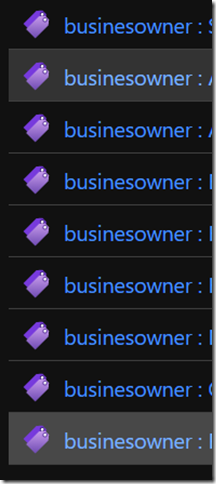
Azure Resource Graph explorer – find the scope and scale of the problem. I’ll add the usual gripe around tags being case sensitive in some places (API, PowerShell) and not in others (Azure Portal!).
Resources
| where tags.businesowner != ”
| project name, subscriptionId, resourceGroup, tags.businessowner, tags.businesowner
by ezs | Feb 15, 2021 | evilzenscientist
Weekend – half a million dead in the US.
Usual weekly update from The Seattle Times. Positive rates are down, folk are becoming complacent again. Continued discussion on back to school.

Friday – another variant in Japan, it’s a race. Dr Fauci says “back to normal by Christmas”.
Thursday – AstraZeneca vaccine reluctance. Rich/Poor divide on vaccine distribution.
Wednesday – Washington State daily cases below 600 for the first time in many months. Daily positive tests down to 6.5%. 10.7% of population have had first vaccine shot. Vaccine production is now the bottleneck. It’s a race against variants/mutations.
Tuesday – more mutations, one of these could be the escapee and massive impact. Real concern that antibiotic use during COVID is accelerating the risk of AMR.
Monday – we’re going to see a lot of “this time last year” posts in the media. Between late January 2020 and late February there was news coverage about the first case in the US – and increasing concern in China and across SE Asia about spread. My post from mid-March 2020 describing this time. Still in the office at that point.
https://www.theguardian.com/world/series/coronavirus-live
https://www.seattletimes.com/tag/coronavirus/
by ezs | Feb 12, 2021 | evilzenscientist
Weekend – cases declining in Washington State, positive rate is relatively stable at just under 8%.
US Daily reported cases below 100k/day for the first time since the end of October 2020. Data from JHU.
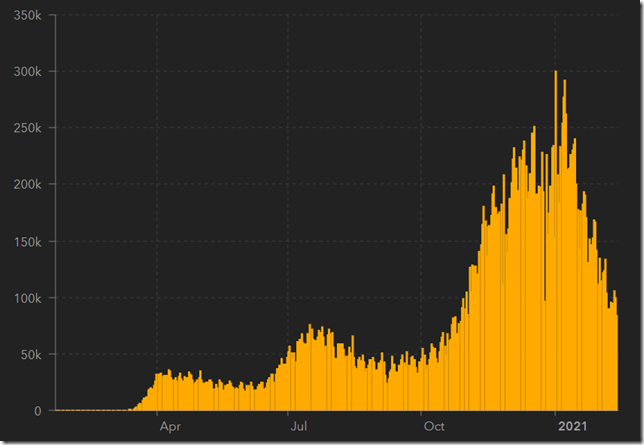
Weekend numbers from The Seattle Times.

Friday – UK hits 21% of population with at least one vaccine shot.

Thursday – WHO continue to search for the origin of this coronavirus. 600M vaccines by July for US. Population should be vaccinated by summer.
Wednesday – as vaccines continue to be rolled out, counties, countries are starting to open back up.
Tuesday – “Wuhan lab leak” unlikely to be source of coronavirus. Continued border closures as governments try to extinguish spread.
Monday – UK variant of COVID-19 is rapidly spreading in the US. Slowly vaccines are getting delivered.
https://www.theguardian.com/world/series/coronavirus-live
https://www.seattletimes.com/tag/coronavirus/
by ezs | Feb 10, 2021 | evilzenscientist
Using KQL against Azure Resource Graph; and here’s another useful snippet – it’s faster by far than PowerShell, subsecond result set.
RecoveryServicesResources
| join kind=leftouter (ResourceContainers | where type==’microsoft.resources/subscriptions’ | project SubName=name, subscriptionId) on subscriptionId
| where type == “microsoft.recoveryservices/vaults/backupjobs”
| where properties.backupManagementType == “AzureIaasVM”
| extend rsg = replace(“;[[:graph:]]*”, “”, replace(“iaasvmcontainerv2;”,””,tostring(properties.containerName)))
| extend vmname = tolower(tostring(properties.entityFriendlyName))
| extend rsvault = tolower(replace(“/[[:graph:]]*”,””, replace(“[[:graph:]]*\\/vaults\\/”,””,id)))
| extend backupage = datetime_diff(‘day’, now(), todatetime(properties.endTime))
| project SubName, rsg, vmname, rsvault, properties.operationCategory, properties.status, backupage
by ezs | Feb 7, 2021 | evilzenscientist
Back to “Azure Grim Reaper” – flagging and deleting unused storage in Azure.
There is no “nice” way to do this – the Azure Metrics help a lot.
Here’s some code that enumerates a list of subscriptions and pulls out storage accounts, transactions over a period of time, count of storage containers, tables and queues – and reads tags.
It’s generic enough for use in most places.
# setup
#import-module az
#import-module az.storage
# creds
#connect-azaccount
#
# set up array of subs
$subs= ‘<subscription ID>’, ‘<subscription ID>’
# today
$nowdate = Get-Date
#initialise output
$stgdata =@()
Write-Host “Enumerating” $subs.count “subscription(s)”
# loop through the subscription(s)
foreach ($subscription in $subs) {
# in subscription, next read the storage accounts
#set context
write-host “Switching to subscription” $subscription
set-azcontext -subscription $subscription |out-null
write-host “enumerating storage accounts”
$stgacclist = get-azstorageaccount
write-host “Total of” $stgacclist.count “storage accounts in subscription” $subscription
# loop through each storage account
foreach ($stgacc in $stgacclist) {
# in storage account, get all storage containers, tables and queues
# stgacc entity has StorageAccountNme and ResourceGroupName and tags
set-azcurrentstorageaccount -Name $stgacc.StorageAccountName -ResourceGroupName $stgacc.ResourceGroupName
write-host “enumerating storage account ” $stgacc.StorageAccountName ” in resource group” $stgacc.ResourceGroupName
write-host “storage containers”
$stgcontainers = get-azstoragecontainer
write-host “table service”
$tblservice = get-azstoragetable
write-host “queue service”
$qservice = get-azstoragequeue
#get transactions
$transactions = Get-AzMetric -ResourceId $stgacc.id -TimeGrain 0.1:00:00 -starttime ((get-date).AddDays(-60)) -endtime (get-date) -MetricNames “Transactions” -WarningAction SilentlyContinue
write-host “60 days of transactions” $(($transactions.Data | Measure-Object -Property total -Sum).sum)
#reset usage array
$lastused = @()
#loop through each blob service container
foreach ($container in $stgcontainers) {
# in blob storage container
write-host “collecting blob storage data”
$lastused += [PSCustomObject]@{
Subscription = $subscription
ResourceGroup = $stgacc.ResourceGroupName
StorageAccount = $stgacc.StorageAccountName
StorageContainer = $container.name
LastModified = $container.lastmodified.Date
Age = ($nowdate – $container.LastModified.Date).Days
}
#let’s find any unmanaged disks in the container
$allblobs = get-azstorageblob -container $container.name
$vhdblobs = $allblobs | Where-Object {$_.BlobType -eq ‘PageBlob’ -and $_.Name.EndsWith(‘.vhd’)}
}
write-host “Total of ” $stgcontainers.count “containers. Minimum age ” ($lastused.Age |Measure -Minimum).minimum “maximum age” ($lastused.Age |Measure -Maximum).maximum
#append to the array
$stgdata += [PSCustomObject]@{
Subscription = $subscription
ResourceGroup = $stgacc.ResourceGroupName
StorageAccount = $stgacc.StorageAccountName
Transactions = $(($transactions.Data | Measure-Object -Property total -Sum).sum)
ContainerCount = $stgcontainers.Count
TableCount = $tblservice.Count
QueueCount = $qservice.Count
AgingMin = ($lastused.Age |Measure -Minimum).minimum
AgingMax = ($lastused.Age |Measure -Maximum).maximum
vhd = $vhdblobs.count
blobs = $allblobs.count
#tag metadata
itowner = $stgacc.tags.itowner
businessowner = $stgacc.tags.businessowner
application =$stgacc.tags.application
costcenter = $stgacc.tags.costcenter
}
}
}
#output to csv
$stgdata | export-csv <somelocation>\storageacc.csv -force -NoTypeInformation


Recent Comments